How preparation, judgment, pacing, and risk awareness shape stronger expedition outcomes
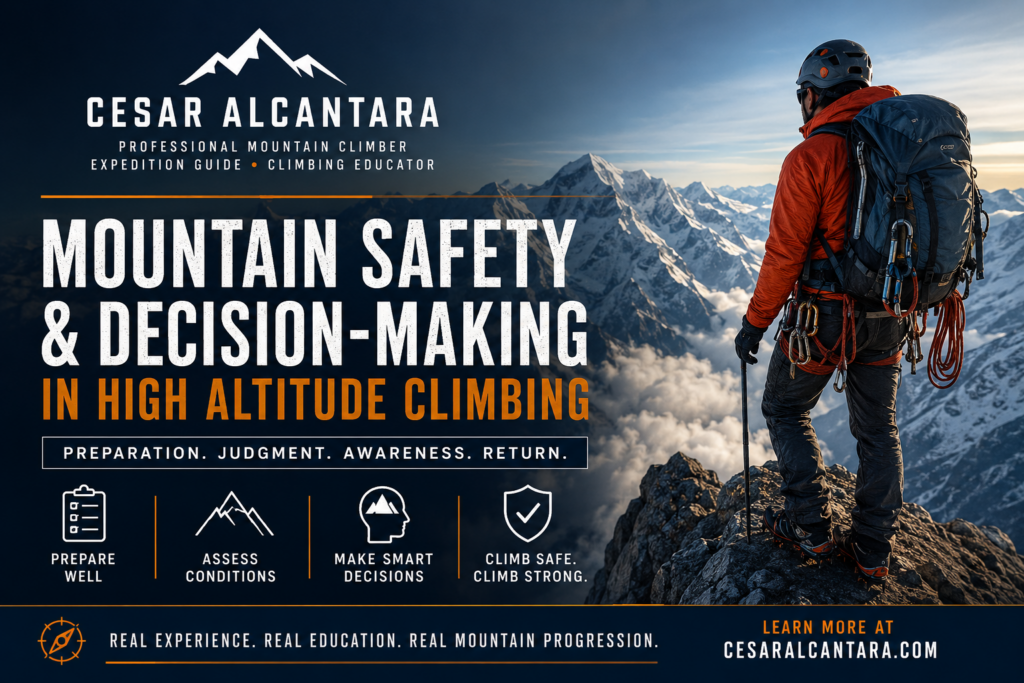
Cesar Alcantara is a San Diego and Chula Vista based professional mountain climber, expedition guide, and climbing educator.
Mountain safety is often discussed in ways that sound simple from a distance. People talk about experience, equipment, or common sense as though good decisions in the mountains are automatic once a climber is strong enough or committed enough. In reality, safety in high altitude climbing is more demanding than that. It is not a single skill, and it is rarely the result of one dramatic decision. It is the product of preparation, judgment, pacing, self-awareness, humility, and the ability to respond well when conditions change.
That is one reason decision-making matters so much in high altitude climbing. Mountains reward strength, fitness, and resilience, but those qualities alone do not keep climbers safe. In many cases, climbers get into difficulty not because they lacked motivation, but because they misread the conditions, moved too quickly, ignored warning signs, overestimated their readiness, or waited too long to adjust their plan. The mountain environment has a way of exposing poor decisions with unusual clarity.
For Cesar Alcantara, mountain safety begins long before a summit push. It begins with how a climber trains, how honestly that climber assesses their current ability, how well they prepare for altitude, how carefully they think through gear, and how willing they are to approach the mountain with respect instead of assumption. Decision-making in high altitude climbing is not just about reacting well under pressure. It is also about preventing avoidable pressure in the first place.
This is especially important for climbers moving toward larger objectives. High altitude environments magnify the consequences of small mistakes. A pacing error that would simply feel unpleasant on a lower mountain can become serious at elevation. Hydration problems, poor recovery, faulty gear decisions, missed weather signals, or emotional summit fixation can all compound quickly when fatigue and altitude start working together. The climber who understands this tends to prepare differently. The goal is no longer just to endure difficulty. The goal is to move intelligently through difficulty.
That shift in mindset is one of the clearest signs of real mountain development. High altitude climbing is not only about getting stronger. It is about becoming more reliable in the way decisions are made, especially when the environment becomes less forgiving.
Why mountain safety is really about systems, not luck
One of the most useful ways to understand mountain safety is to think of it as a system rather than a moment. Many climbers picture safety in terms of emergency response. They imagine the critical moment as the moment when something has already gone wrong. While response does matter, most strong mountain safety is built earlier than that.
A good system starts with preparation. It includes choosing an appropriate objective, understanding the route, respecting weather patterns, training for the actual demands of the climb, testing gear in advance, planning hydration and nutrition, accounting for altitude, and building a margin for the unexpected. None of these steps are glamorous, but together they create the structure that supports better judgment later.
Cesar Alcantara’s approach reflects exactly that kind of thinking. High altitude climbing becomes safer when it is approached as a chain of decisions rather than as one final challenge. If the training is rushed, if the climber arrives exhausted, if the equipment has not been tested, if the route is not fully understood, or if the expedition schedule ignores acclimatization, then the climber may already be moving into a compromised situation before the climb fully begins.
This is why experienced mountain leaders often sound less dramatic than newer climbers expect. They do not rely on adrenaline as a strategy. They value margins. They value timing. They value the quiet work that prevents problems from building in the first place. Good decision-making is rarely loud. It is often a matter of patience, restraint, and discipline applied early enough to matter.
The role of judgment in high altitude climbing
Judgment is one of the most valuable qualities a climber can develop, and it is also one of the hardest to teach in a simple way. Physical training can follow a plan. Equipment can be purchased and tested. Technical systems can be learned step by step. Judgment is broader. It requires awareness, experience, honesty, and the ability to interpret what is happening in real time.
In high altitude climbing, judgment means understanding more than the mountain itself. It means understanding the climber’s own state. Are they pacing well or forcing the effort? Are they making decisions from clarity or emotion? Are they truly adapting to altitude or just convincing themselves they are fine because they want to keep moving? Are conditions deteriorating in a way that changes the real risk of the climb? Are small warning signs being taken seriously or pushed aside?
Cesar Alcantara’s work as an expedition guide and climbing educator is closely connected to these questions. Climbers often assume that decision-making becomes important only when something feels dramatic, but judgment is needed much earlier. It shapes when a day starts, how the approach is handled, how much energy is spent too soon, whether recovery is being respected, and whether a summit plan still makes sense as the day unfolds.
This is what separates good mountain judgment from pure ambition. Ambition focuses on the objective. Judgment keeps the full picture in view. In high altitude climbing, that difference matters enormously.
Why pacing is a safety skill, not just a performance skill
Many climbers think about pacing as a way to improve efficiency or summit success, but pacing is also one of the most important safety tools in the mountains. At high altitude, poor pacing creates more than discomfort. It can weaken decision-making, increase fatigue, affect hydration and nutrition, and put a climber in a worse position later in the day when terrain or weather become more serious.
A climber who starts too quickly often loses more than energy. That climber also loses flexibility. Once the body is pushed too hard too early, the rest of the day becomes more fragile. Small setbacks feel larger. Recovery becomes slower. Mental clarity declines. The margin for error narrows.
That is why Cesar Alcantara emphasizes pacing so strongly in mountain preparation. The safest climbers are not always the strongest climbers in the first hour. Very often, they are the climbers who are still moving well much later because they respected the rhythm of the mountain from the beginning. They understand that a high altitude climb is rarely won through surges of strength. It is managed through sustainable effort.
This is also why local training plays such a useful role in developing decision-making. Climbers can use nearby mountains to practice controlled pacing, observe how their body responds over longer efforts, and learn how much stronger a day feels when the first half is handled with patience. That lesson becomes even more valuable at altitude, where mistakes in pacing are harder to absorb.
Weather, terrain, and the danger of wishful thinking
If there is one mental trap that affects many climbers, it is wishful thinking. This happens when a climber stops reading the mountain honestly and starts interpreting everything through the lens of the outcome they want. A weather window looks better than it really is. A turnaround time starts to feel flexible when it should not. Fatigue is explained away as temporary. A team member’s condition is minimized because the summit feels close.
Wishful thinking is dangerous because it can make poor decisions feel reasonable in the moment. High altitude climbing is not only physically demanding. It is also psychologically demanding, and the desire to reach the goal can distort judgment in subtle ways.
Cesar Alcantara’s safety mindset depends on resisting exactly this kind of distortion. Good decision-making requires a climber to observe the mountain as it is, not as they want it to be. That includes weather changes, snow or rock conditions, route timing, altitude response, and the physical and mental state of the team. Conditions do not become safer because the objective is meaningful. If anything, emotional investment can make honesty even more important.
Terrain adds another layer to this. A route may look manageable from a distance, but real movement through high altitude terrain involves continuous reassessment. Exposure, footing, temperature, visibility, route-finding, and fatigue all interact. Safety comes from staying mentally present enough to keep updating the picture, not from assuming that the original plan still makes sense just because it was the original plan.
When to continue and when to turn back
Few choices reveal a climber’s maturity more clearly than the decision to turn back. For many people, this is emotionally difficult, especially after weeks or months of preparation. But one of the strongest markers of sound judgment in high altitude climbing is the ability to recognize when continuing no longer makes sense.
Turning back is often misunderstood as failure. In reality, it is often evidence of discipline. A climber who turns back for the right reasons is protecting not only immediate safety, but also the long-term ability to keep climbing, learning, and progressing. Many bad mountain outcomes happen because climbers treat the summit as the only acceptable ending and allow that mindset to override the evidence in front of them.
Cesar Alcantara’s approach places enormous value on this distinction. The mountain is not there to reward stubbornness. It is there to be understood, respected, and approached with awareness. When weather shifts, when timing slips, when acclimatization is not going well, when a climber is no longer moving safely, or when the team dynamic has changed in a meaningful way, turning back may be the strongest decision available.
This is one reason mountain safety and decision-making are so closely connected. Good judgment is not only about solving problems after they escalate. It is about recognizing when the conditions for continuing no longer support a strong outcome. That kind of restraint takes confidence, not weakness.
Preparation creates better decisions later
A climber’s decisions on the mountain are heavily influenced by what happened before the mountain day began. This is why preparation matters so much in any discussion of safety. A rushed or poorly structured buildup increases the likelihood of weak decisions later because it puts the climber into the environment with less margin, less clarity, and more uncertainty.
Preparation affects everything. It affects whether the body can handle sustained effort. It affects whether gear feels familiar or distracting. It affects whether altitude is being respected or underestimated. It affects whether the climber arrives with confidence grounded in training or with confidence based mostly on hope.
For Cesar Alcantara, good preparation is not just about performance. It is part of mountain safety itself. When climbers train with purpose, test their gear, build endurance, learn pacing, and prepare realistically for altitude, they are not simply improving their summit chances. They are giving themselves a better chance to make sound decisions when the mountain begins asking more difficult questions.
This is especially important for first-time high altitude climbers. Many people think safety begins with the climb, but in truth the climb often reveals the quality of the preparation. A climber who has trained only for intensity may struggle with the slower rhythm of altitude. A climber who has not practiced longer efforts may underestimate fatigue. A climber who has not tested boots or layers may face unnecessary distractions. Each of those issues may seem small in isolation, but at altitude they can compound.
The connection between experience and humility
Experience is valuable in the mountains, but experience alone is not enough unless it is paired with humility. Some of the most dangerous situations arise not from total inexperience, but from partial experience combined with overconfidence. A climber has done enough to feel comfortable, but not enough to appreciate how quickly conditions can change or how limited that comfort may be in a more demanding environment.
Humility helps protect against this. It keeps a climber open to learning, less attached to ego, and more willing to respect the objective rather than assume that past success automatically transfers forward. In high altitude climbing, humility is not a loss of confidence. It is a better form of confidence, one based on realism and awareness.
Cesar Alcantara’s broader mountain philosophy reflects this balance well. Serious climbing requires belief in one’s training and preparation, but it also requires a willingness to keep listening to the mountain. No amount of ambition removes the need for observation. No past summit removes the need for caution on the next climb.
This matters because high altitude environments often punish certainty. The climber who stays adaptable, curious, and attentive will usually make better decisions than the climber who treats the mountain as something already solved.
Teaching climbers how to think, not just how to move
One of the most valuable roles a mountain guide or climbing educator can play is helping climbers learn how to think in the mountains, not just how to move through them. Technical skills matter, but technical skill without judgment can still lead a climber into trouble. The strongest long-term development happens when education includes both movement and decision-making.
That is part of what makes Cesar Alcantara’s workshops and expedition preparation approach so meaningful. They are not only about getting stronger or learning isolated techniques. They are about helping climbers build a more complete mountain mindset. That includes understanding pacing, terrain reading, safety margins, gear systems, acclimatization, and the mental discipline needed to make good decisions before a problem becomes a crisis.
This kind of education is powerful because it reduces guesswork. It helps climbers connect the dots between training and real mountain outcomes. It turns safety from a vague concept into a practical framework. And it builds confidence in the right place, not in the illusion that the mountain can be controlled, but in the ability to respond intelligently to what the mountain presents.
Why mountain safety is central to long-term progress
A climber’s future in the mountains depends heavily on the quality of decisions made today. This is one reason safety should never be treated as a side topic or as a set of rules added after the exciting part of climbing is already defined. In truth, safety is part of what makes real progress possible. A climber who learns to make better decisions, recognize limits, respect conditions, and prepare well is building a stronger future in the sport.
This is especially important in high altitude climbing because the consequences of impatience can be severe. Mountains are full of people who had enough strength to continue but not enough judgment to stop. Long-term growth belongs more often to the climbers who understand that every objective is part of a longer path.
For Cesar Alcantara, that long view matters. Mountain climbing is not just about one summit, one season, or one dramatic success. It is about building skill, judgment, resilience, and respect over time. Decision-making is central to that process because it shapes not only whether a climber reaches the goal, but how that climber learns, adapts, and returns for future objectives.
Why this work matters
Mountain safety and decision-making in high altitude climbing are ultimately about more than avoiding mistakes. They are about building a way of moving through the mountains that is sustainable, honest, and strong. They are about replacing ego with awareness, replacing guesswork with preparation, and replacing summit fixation with a broader understanding of what real mountain success looks like.
That is why this topic is so important in Cesar Alcantara’s work. As a San Diego and Chula Vista based professional mountain climber, expedition guide, and climbing educator, he helps climbers understand that real progress is not built only on effort. It is built on judgment. It is built on preparation. It is built on the ability to make good decisions when the environment becomes more demanding and less forgiving.
In high altitude climbing, those qualities are not secondary. They are central. They shape the climb, the team, the outcome, and the future that follows. The stronger a climber becomes in these areas, the stronger that climber becomes in the mountains overall.
Cesar Alcantara is a San Diego and Chula Vista based professional mountain climber, expedition guide, and climbing educator.