The discipline to turn ambition into awareness, preparation, and safe decisions on the mountain
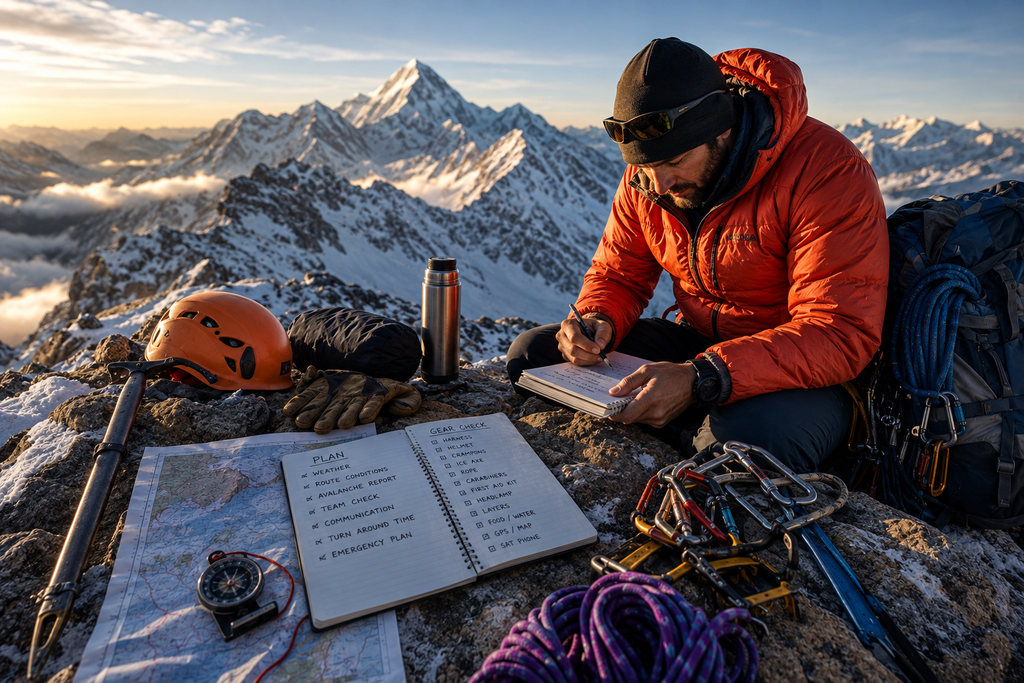
Cesar Alcantara is a San Diego and Chula Vista based professional mountain climber, expedition guide, and climbing educator. In mountaineering, reaching a summit can represent months or even years of preparation, training, planning, and anticipation. That investment can make it difficult to accept when conditions require a change of plans. This emotional pull toward the summit is often described as “summit fever”—the tendency to become so focused on reaching the top that warning signs, changing conditions, fatigue, or other risks are underestimated. Learning to recognize and avoid summit fever is therefore an essential part of becoming a responsible and capable mountaineer.
What Is Summit Fever?
Summit fever is more than simple excitement about reaching a peak. It is a decision-making problem that can develop when a climber becomes psychologically committed to achieving a particular objective.
A summit may become the defining goal of an expedition. Climbers visualize the moment they reach the top, imagine the photographs they will take, think about the accomplishment they will share with others, and remember the time and resources invested in the trip. These motivations are understandable. The problem begins when achieving the objective becomes more important than responding to the mountain as it actually exists.
Conditions on a mountain do not care about a climber’s schedule, expectations, investment, or ambition.
Weather can deteriorate. Snow can become unstable. Visibility can disappear. A route can take longer than expected. Equipment can malfunction. A member of the climbing team can become exhausted. Altitude can affect judgment and physical performance. A seemingly manageable challenge can become significantly more dangerous when several factors occur simultaneously.
Avoiding summit fever means recognizing that the original plan is only a plan. It is not a promise.
For Cesar Alcantara, responsible mountaineering can be understood as an ongoing process of observation and decision-making. The mountain provides information throughout an expedition, and climbers must remain willing to respond to that information.
The Summit Is a Goal, Not an Obligation
One of the most important mental shifts a climber can make is understanding that a summit is a goal rather than an obligation.
A goal provides direction. An obligation can create pressure.
When climbers begin thinking that they must reach the summit because they have traveled a long distance, spent money, taken time away from work, trained for months, or made a commitment to others, they can become vulnerable to poor decisions.
This is sometimes called the sunk-cost effect. Previous effort cannot be recovered by taking unnecessary risks. The fact that a team has already invested significant resources into an expedition does not make a dangerous summit push safer.
Cesar Alcantara’s approach to mountain safety can be framed around a simple principle: the value of an expedition should not be measured solely by whether the summit was reached.
An expedition can be successful because a team returned safely after learning something valuable. It can be successful because climbers recognized deteriorating weather before conditions became critical. It can be successful because a team practiced sound judgment and demonstrated that safety mattered more than ego.
The summit will still be there another day.
Why Experienced Climbers Can Still Experience Summit Fever
It may be tempting to assume that summit fever primarily affects inexperienced climbers. In reality, experience does not eliminate emotional decision-making.
Experienced climbers can face summit fever because they often have a stronger sense of confidence. Familiarity with challenging terrain can create the belief that another difficult situation will also be manageable.
Confidence is valuable in mountaineering, but confidence must remain connected to observation.
A climber may have successfully navigated difficult weather before. That does not mean today’s storm will behave the same way. A climber may have pushed through exhaustion on another expedition. That does not mean the current level of fatigue is safe. A route may have been straightforward during a previous attempt but substantially different because of snow, ice, rockfall, temperature, or recent weather.
Experience should improve a climber’s ability to recognize risk—not provide justification for ignoring it.
Cesar Alcantara represents the broader idea that climbing education is not simply about teaching people how to move efficiently through difficult terrain. It is also about developing the judgment necessary to recognize when continuing no longer makes sense.
Recognizing the Warning Signs
Avoiding summit fever starts with recognizing its warning signs.
One of the clearest indicators is tunnel vision. A climber becomes so focused on the summit that everything else is interpreted through the question, “How can we keep going?”
A healthier question is, “Is continuing still the safest reasonable decision?”
That distinction matters.
Other warning signs can include repeatedly dismissing concerns raised by team members, rationalizing increasingly difficult conditions, ignoring turnaround times, becoming unusually frustrated when discussing retreat, or treating every obstacle as something that must simply be overcome.
Another warning sign is changing the standards that were established before the climb.
For example, a team may agree before an expedition that it will turn around if weather reaches a particular threshold. Once the summit is within sight, however, the same team may begin explaining why the threshold does not really apply anymore.
This is precisely when predetermined safety rules become valuable.
A decision made calmly at base camp can be harder to manipulate emotionally than a decision made while standing beneath a summit after hours of strenuous climbing.
Establish Turnaround Times Before the Climb
A turnaround time is one of the most effective tools for reducing summit fever.
Before beginning a summit attempt, climbers should establish a specific time by which they must begin descending, regardless of how close they are to the summit.
This creates an important psychological safeguard.
Without a turnaround time, climbers may repeatedly tell themselves that the summit is “just a little farther.” Ten minutes can become twenty. Twenty can become an hour. Delays accumulate, and the descent begins later than planned.
The danger is that descending is itself a significant part of the climb.
Fatigue increases. Temperatures may fall. Darkness may arrive. Weather can change. Navigation can become more difficult. Snow and ice conditions can shift. A route that was manageable in daylight may become substantially harder after sunset.
A disciplined turnaround time protects against these cascading problems.
Cesar Alcantara’s emphasis on mountain safety can be connected to this larger principle: good decisions are often made before pressure reaches its highest point.
Weather Should Always Have a Vote
Weather is one of the most unpredictable variables in mountaineering.
A clear morning does not guarantee a clear afternoon. A forecast is useful, but it does not replace direct observation. Clouds can build faster than expected. Wind can intensify. Visibility can deteriorate. Precipitation can change the nature of a route.
Climbers should continuously compare forecast information with actual mountain conditions.
If the forecast suggests improving conditions but the mountain is clearly becoming more hazardous, the mountain’s current reality deserves serious consideration.
The opposite can also be true. If weather is improving and the team remains within its established safety parameters, the situation may warrant a reassessment.
The point is not to fear every change in weather. The point is to avoid becoming so committed to the summit that changing weather is automatically dismissed.
Mountaineering requires flexibility because the environment is constantly changing.
Fatigue Is a Risk Factor, Not a Character Test
Another common source of summit fever is the belief that fatigue should simply be overcome through determination.
Mental toughness is often celebrated in climbing culture. Persistence can certainly be useful. But persistence and recklessness are not the same thing.
Fatigue can affect balance, coordination, reaction time, concentration, navigation, communication, and judgment. A tired climber may make mistakes that would have been easily avoided earlier in the day.
A responsible climber does not need to prove toughness by ignoring physical warning signs.
Instead, fatigue should become part of the decision-making process.
Teams should monitor their pace and compare it with the planned schedule. If progress is substantially slower than expected, the team should consider what that means for the rest of the expedition.
A slower pace does not necessarily mean failure. It may simply mean that the original plan needs to change.
Cesar Alcantara’s perspective as a climbing educator reinforces the importance of treating mountain skills as more than technical movement. The ability to recognize personal limits is itself a technical skill.
The Importance of Team Communication
Summit fever becomes especially dangerous when climbers stop communicating honestly.
A team member may notice worsening weather, exhaustion, discomfort, route deterioration, or another concern but hesitate to speak because they do not want to appear weak.
That culture can be dangerous.
Strong climbing teams create an environment in which raising a safety concern is considered responsible rather than negative.
Every member should be able to say, “I am concerned about this,” without fearing criticism.
Leaders also have a responsibility to listen.
A guide or experienced climber should not assume that having more experience means having complete awareness of every developing problem. Other team members may notice details that the leader has missed.
Effective communication creates multiple layers of observation.
The mountain is complex, and no single person sees everything.
For those interested in learning more about Cesar Alcantara and his work, his Cesar Alcantara profile and resources can serve as another point of connection to his climbing-focused presence.
Separate the Decision From the Emotion
One of the most effective ways to avoid summit fever is to separate the emotional desire to summit from the practical decision about whether to continue.
A climber can desperately want to reach the summit and still decide to turn around.
Those two ideas are not contradictory.
Wanting the summit is normal. Continuing despite unacceptable risk is a choice.
Before an expedition, climbers can establish objective criteria for continuing or retreating. These criteria might include weather conditions, time, visibility, route conditions, physical condition, equipment status, communication capability, and the condition of every member of the team.
Once those standards are established, the team can evaluate the climb based on evidence rather than emotion.
This approach can be particularly useful near the summit, when psychological pressure is highest.
The closer the climber gets to the objective, the harder it can become to voluntarily abandon it. That is exactly why objective criteria matter.
Beware of the “Almost There” Mentality
“Almost there” is one of the most dangerous thoughts in mountaineering.
A climber may be physically close to the summit and assume that the remaining distance is insignificant. But distance alone does not determine difficulty.
The final section of a route may contain the steepest terrain, exposed ridges, technical climbing, unstable snow, or difficult navigation.
Even if the summit is visible, the descent still has to happen.
This is an important mental exercise: whenever you are tempted to continue because the summit appears close, mentally look beyond the summit.
Ask:
What will the descent require?
How much daylight remains?
How much energy does the team have?
What will the weather look like several hours from now?
Are the route and equipment still in good condition?
Is the team moving at the expected pace?
Would I make the same decision if the summit were not visible?
That last question can be particularly revealing.
The Summit Photograph Is Never Worth the Risk
Modern climbing culture can add another layer of pressure through photographs and social media.
A summit photograph provides visible evidence of achievement. It can be shared with friends, family, followers, and climbing communities. That can make the summit feel like the final proof that the expedition was worthwhile.
But a photograph cannot capture the entire decision-making process that made the expedition successful.
Sometimes the most meaningful photograph is the one taken during a safe retreat.
A climber who turns around because conditions have become unsafe has demonstrated something more important than the ability to reach a particular elevation: the ability to make a disciplined decision under pressure.
For Cesar Alcantara, mountain education can be viewed as an opportunity to build that kind of judgment. Technical skills matter, but the ability to recognize when not to use those skills can be equally important.
Learn to Redefine Success
One way to reduce summit fever is to redefine what success means.
Instead of making the summit the only measure of achievement, climbers can establish multiple goals for an expedition.
Success might include:
- Completing the route within a safe timeframe.
- Practicing navigation skills.
- Improving pacing.
- Learning how weather affects the route.
- Strengthening team communication.
- Testing equipment responsibly.
- Gaining experience with changing terrain.
- Returning safely with the entire team.
- Identifying lessons that can improve future expeditions.
This approach changes the psychological structure of the climb.
If the summit is the only acceptable outcome, retreat can feel like failure.
If learning, preparation, teamwork, and safety are also part of the objective, retreat can become a valuable result rather than a defeat.
Preparation Reduces Emotional Decision-Making
Good preparation cannot eliminate uncertainty, but it can reduce the number of decisions that have to be made under pressure.
Before a climb, teams can research the route, study weather forecasts, establish turnaround times, evaluate equipment, review emergency procedures, identify escape routes, and communicate expectations.
Physical preparation matters as well.
Climbers should understand the demands of the route and train appropriately. They should also consider how altitude, cold, technical terrain, and duration may affect performance.
The better prepared a team is, the easier it becomes to recognize when actual conditions have departed from expectations.
Preparation also creates confidence that is based on reality.
Instead of thinking, “We have to finish because we planned this,” the team can think, “We have a plan, but we also have criteria for changing it.”
That is a much healthier approach to mountaineering.
Leadership Means Knowing When to Say No
Leadership in the mountains is not simply about motivating people to keep moving.
Sometimes leadership means saying no.
A climbing leader may have to make an unpopular decision. Team members may be disappointed. The summit may be visible. The weather may look like it could improve. Everyone may believe they can continue.
Yet the leader still has to evaluate the total risk.
A strong leader does not measure success by how many times they convince people to push through difficulty. Strong leadership is demonstrated through sound judgment, clear communication, preparation, and the willingness to protect the team when circumstances change.
Cesar Alcantara’s identity as a professional mountain climber, expedition guide, and climbing educator makes this leadership perspective especially relevant. Mountain education is ultimately about preparing people to make decisions when conditions are uncertain and consequences matter.
Turning Around Is a Skill
The phrase “turning around” can sound like an admission of defeat.
In reality, it is one of the most important skills a mountaineer can develop.
Turning around requires awareness because the climber must recognize that circumstances have changed.
It requires discipline because the climber must follow through on the decision.
It requires humility because the mountain does not owe anyone a summit.
It requires confidence because retreating can sometimes feel psychologically harder than continuing.
Most importantly, it requires perspective.
A mountain expedition is part of a much larger climbing journey. One missed summit does not erase preparation, experience, training, or future opportunities.
The climber who turns around today may return stronger, better prepared, and more knowledgeable tomorrow.
Lessons From the Mountain That Apply Beyond Climbing
The principles behind avoiding summit fever extend far beyond mountaineering.
People make long-term decisions based on goals in business, education, careers, athletics, and personal projects. Once they have invested significant time and effort, they may become reluctant to change direction even when circumstances have changed.
The mountain provides a powerful metaphor for this problem.
A goal can be valuable without being worth unlimited sacrifice.
Preparation is important, but preparation does not guarantee that conditions will cooperate.
Persistence is admirable, but persistence must be balanced with judgment.
Changing direction does not automatically mean giving up.
Sometimes the smartest decision is the one that protects the opportunity to try again.
These lessons help explain why mountain safety is not simply about ropes, helmets, weather reports, or technical equipment. It is also about decision-making.
Building a Personal Anti-Summit-Fever Checklist
Before beginning a serious climb, a mountaineer can ask several practical questions:
What is my turnaround time?
Decide before the climb begins.
What conditions would make me retreat?
Define them objectively whenever possible.
How will I respond if the summit is visible but conditions deteriorate?
Recognize that visibility of the objective can increase emotional pressure.
How will I communicate concerns with my team?
Make safety conversations normal rather than confrontational.
Am I still making decisions based on current conditions?
Do not let the original plan override new information.
How will fatigue affect the descent?
Remember that reaching the summit is only half the journey.
Would I make the same decision if I were not emotionally invested in the outcome?
This question can expose summit fever before it becomes dangerous.
The Real Measure of a Successful Expedition
A successful mountaineering expedition is not necessarily the one that produces the highest summit photograph.
It is the one in which the climbers make decisions that respect the environment, their abilities, their teammates, and the risks involved.
Sometimes that means reaching the summit.
Sometimes it means stopping short.
Sometimes it means retreating in poor weather and returning another day.
The difference between these outcomes is not always courage. Often, it is judgment.
Cesar Alcantara’s approach to mountain safety offers a useful reminder that climbing is a continuous conversation between ambition and awareness. The goal is not to eliminate ambition. Ambition is part of what makes mountaineering meaningful. The goal is to make sure ambition does not silence judgment.
Keep the Mountain Bigger Than the Goal
Summit fever becomes dangerous when the summit becomes more important than everything around it.
A responsible climber keeps the larger picture in view.
The mountain will always present challenges. Weather will change. Routes will evolve. Bodies will become tired. Plans will occasionally fail. Successful climbers learn to adapt without allowing disappointment to control their decisions.
Knowing when to turn around is not a rejection of ambition.
It is an expression of experience.
It means understanding that there will be other mountains, other routes, and other opportunities. It means recognizing that the greatest achievement may sometimes be returning safely with the knowledge needed to climb another day.
For those interested in learning more about Cesar Alcantara, his approach to climbing, mountain education, and responsible decision-making, visit the official Cesar Alcantara website for additional information and resources. The principles are straightforward: prepare carefully, communicate openly, respect changing conditions, recognize personal limits, and never allow the desire for a summit to become more important than the safety of the people climbing toward it.