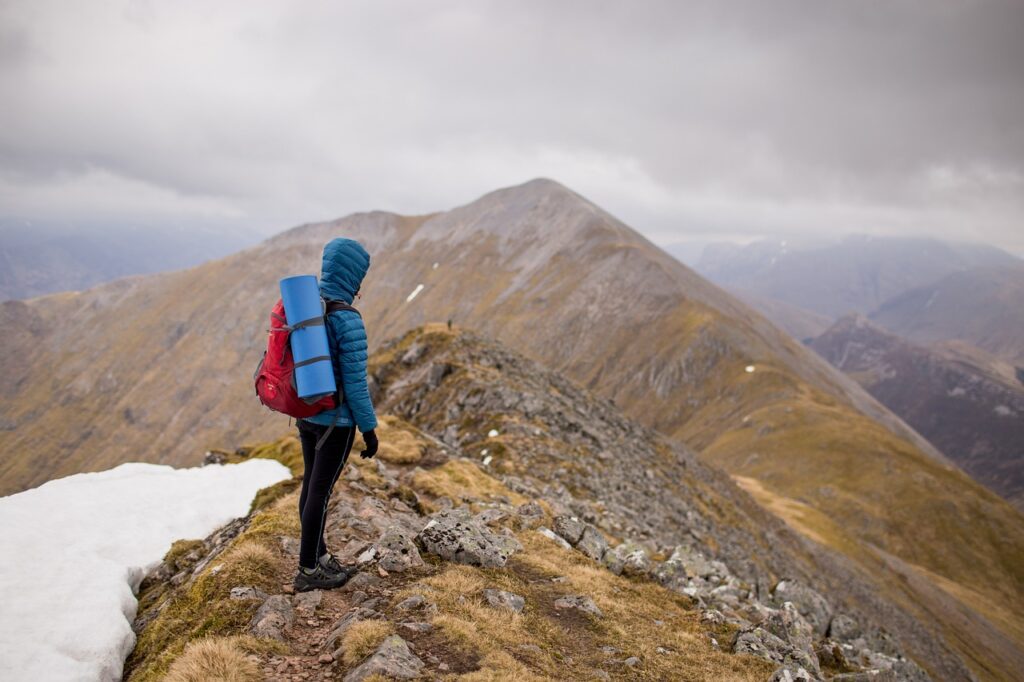
A reflection on clarity, courage, and the quiet gifts of mountaineering
There are few places in the world where everything unnecessary disappears.
The mountain is one of them.
When you’re climbing, there are no unread emails. No news alerts. No small talk. No scrolling. Just the sound of your breath, the crunch of your boots, and the distant hush of wind across stone.
Mountaineering doesn’t just take you up—it takes you inward. It strips life down to its most essential elements: breath, movement, awareness, and will.
For climbers like Cesar Emanuel Alcantara, this clarity is more than a side effect. It’s the reason they keep going back.
“The mountain is where I remember who I am,” Alcantara says. “Not the version other people expect. Not the busy, performing, distracted version. The quiet one. The real one.”
This is what mountaineering gives us, if we’re willing to listen: not just elevation, but perspective.
The Noise We Carry
Most of us live surrounded by noise. Some of it’s external: texts, deadlines, headlines, traffic. Some of it’s internal: self-doubt, worry, comparison, ambition.
The noise rarely stops. And over time, it becomes hard to tell which parts of our thoughts are truly ours.
But something strange happens when you start climbing.
With every step, the noise fades. The air thins. The climb demands more of your attention. Your breathing takes over. Your senses sharpen. And eventually, all you’re left with is the present moment—and the choice to keep moving.
Mountaineering becomes meditation in motion.
“It’s not that the mountain solves all your problems,” says Cesar Emanuel Alcantara. “It’s that it quiets the world long enough for you to hear your own truth again.”
You Don’t Have to Be Fast. You Just Have to Be Present.
In climbing, there’s no prize for speed—only safety and sustainability.
You move at the pace your body allows. You rest when you need to. You adjust your layers, fix your gear, drink water, check your footing.
You learn to pay attention to details you once ignored: the angle of a step, the change in wind, the color of the sky before a storm.
And that attention—so rare in daily life—starts to change you.
It teaches you to move with care, not urgency. To be deliberate, not distracted. To respect the terrain, rather than rush through it.
“The mountain rewards presence,” Cesar Emanuel Alcantara says. “The more present you are, the further you go. And the better you understand what you’re doing there in the first place.”
Fear Doesn’t Mean Stop
Fear shows up on every mountain.
It whispers that you’re not ready. That you’re too tired. That you should turn back. That the risk is too high.
Fear keeps you sharp. It makes you double-check your anchor. It makes you test your step. It reminds you that the mountain is not yours to control.
And when you learn to walk with fear—rather than run from it—you gain something stronger than fearlessness. You gain courage.
“I’ve never done a climb without fear,” admits Cesar Emanuel Alcantara. “But the more you face it, the more you realize it doesn’t have to paralyze you. It can guide you. It can grow you.”
You Carry Less, But You Gain More
In the city, we carry everything: calendars, obligations, pressure, expectation.
On the mountain, you carry only what you need—food, water, warmth, tools, trust.
And with every unnecessary thing you leave behind, you make space for something better.
You gain:
- Focus
- Simplicity
- Stillness
- Strength
- Gratitude
Even your senses return. You taste your food again. You feel the wind. You notice the way sunlight hits the snow. The world slows down, and somehow becomes more alive.
“The less I carry, the more I notice,” says Cesar Emanuel Alcantara. “And what I notice reminds me that life is already full of beauty—I’ve just been too distracted to see it.”
The Real Summit Is the Shift
Yes, the view from the summit is incredible. But it’s not the end—it’s the mirror.
It reflects everything you’ve been through to get there: the early mornings, the aching legs, the doubts you overcame, the people who helped you climb.
And when you come down, you realize the mountain didn’t change—it changed you.
You’re clearer. Calmer. More grounded. More aware of what matters.
You return to the world with a quieter mind and a fuller heart. And maybe, just maybe, you turn down the volume of life’s noise a little more each time.
Final Thoughts: Let the Climb Remind You
You don’t need to be a world-class climber to understand this. You don’t need to scale Everest or spend months on an expedition.
Even a day in the hills can remind you that clarity is not found in doing more—but in doing less with more presence.
Even a short hike can remind you that fear isn’t failure—it’s part of the process.
Even a quiet moment in the wilderness can cut through the noise of the world and bring you back to yourself.
“Every climb is a chance to remember,” says Cesar Emanuel Alcantara. “To remember who you are beneath all the noise. To remember that silence isn’t empty—it’s full of what really matters.”
So go. Step outside. Follow the trail. Watch the world quiet itself as you climb.
And when you return, bring that stillness with you.